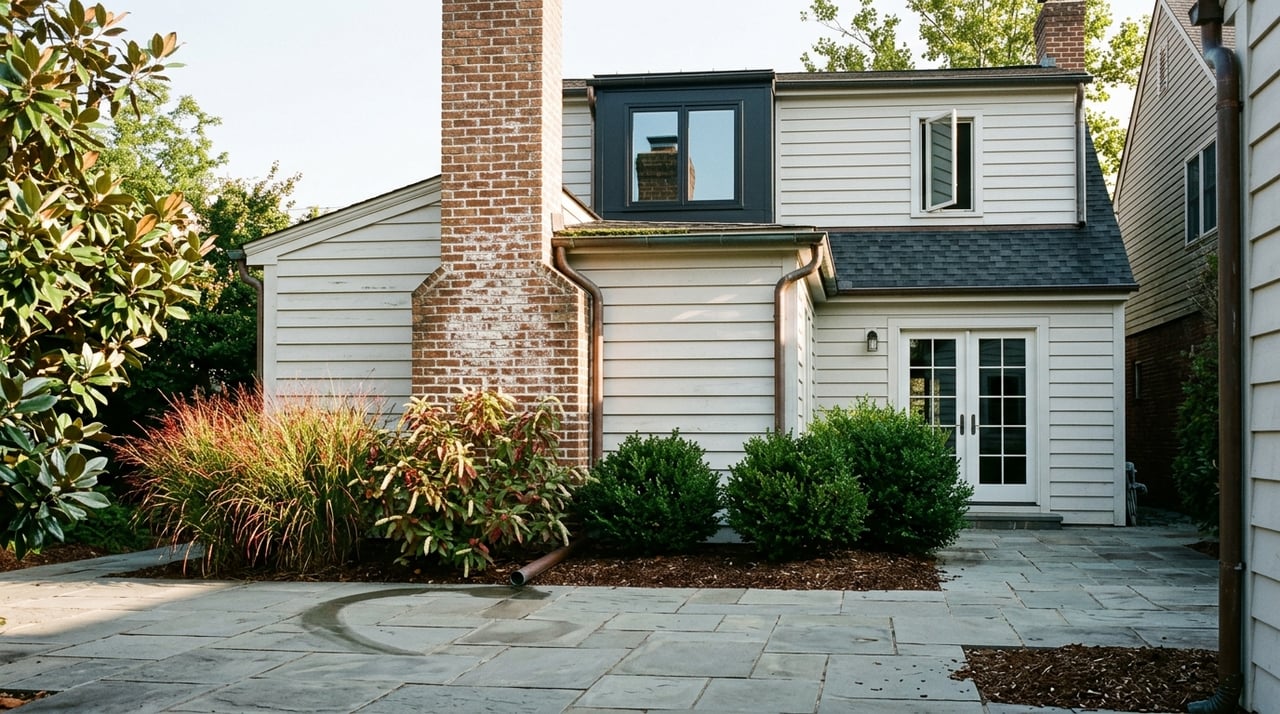
Havre de Grace's Historic District: The Rehab Sequence That Decides Whether You Pay Or Get Paid
A rehabber buys a rowhouse a few blocks off the promenade. It needs new windows, some repointed brick, and a rear addition to make the second floor work as a primary suite. The contractor pulls permits the way he always does, on a Tuesday, and has the old sashes out by Thursday. By Friday, the city has issued a stop-work order. Nobody told him the property sits inside a designated historic district, and in Havre de Grace, that single fact changes the order in which every other step has to happen.
This is not a story about red tape for its own sake. It's a story about sequencing, and sequencing is the part most guides to historic districts skip. The rule that stopped this project isn't really a cost. It's a gate. Walk through it in the right order and the same designation that just froze a job site can hand back thousands of dollars. Walk through it out of order and you lose the money and the schedule at the same time.
Havre de Grace's preservation ordinance, Chapter 97 of the city code, requires a Certificate of Appropriateness before any construction, alteration, or demolition that changes the exterior of a designated landmark, or of a structure inside a designated historic district, if that change is visible from a public way. No COA, no building permit. The Director of Planning is barred from issuing one without it.
The part most owners don't expect: the Historic Preservation Commission has 45 days to act on a completed application. If it doesn't, the code treats that silence as automatic approval. That's a real deadline, not an open-ended bureaucratic hold, and it's the number a rehabber should be writing into a project timeline before a contractor ever shows up with a dumpster.
It's tempting to assume historic district rules only apply to a handful of postcard properties, the kind with placards out front. Havre de Grace's own planning documentation says otherwise. A 1979 study by Harford County first defined the district, and by the time it was listed on the National Register in 1982 it covered roughly 1,100 properties, of which nearly 800 were designated as contributing to the district's historic and architectural significance. The footprint runs from Juniata Street eastward to the waterfront, covering most of downtown and the older residential blocks around it. Individually listed contributors within that same district include the Concord Point Lighthouse and the Lock House Museum, so the boundary isn't abstract. If you're evaluating a fixer anywhere in that stretch, the odds are good that it's a contributing structure whether or not the listing sheet says so.
Here's where the confusion usually starts. People hear "historic district" and assume it means one thing: the National Register listing. In practice, two separate designations are doing two separate jobs, and conflating them is what leads owners to guess wrong about their own obligations.
The National Register of Historic Places is the honorary listing, the one tied to the city's history and to eligibility for state tax incentives. It doesn't, by itself, dictate what you can do to your siding. The regulatory teeth come from the local historic district zoning the city adopted through Maryland's Enabling Act for Historic Area Zoning, and from the local landmark designations approved by the Historic Preservation Commission. That's the layer that actually requires the Certificate of Appropriateness. In Havre de Grace, the two footprints overlap closely, which is exactly why people assume they're the same rule. They aren't, and the difference matters the moment you start planning around one of them.
Here's the flip side, and it's the part that makes the sequencing argument worth making. Maryland's Historic Revitalization Tax Credit Homeowner Tax Credit, run through the Maryland Historical Trust, refunds 20 percent of qualified rehabilitation expenditures on a certified historic, owner-occupied structure, capped at $50,000 in credit within any 24-month period, with a $5,000 minimum in qualifying spend. The program has historically carried no annual cap on how many homeowners statewide can claim it, unlike the state's competitive commercial credit, which runs on a yearly application deadline.
The catch is timing, and it's the same catch that trips up the COA process. Work that starts before the Trust reviews and approves the project does not qualify, full stop, and can jeopardize the credit for the entire job. I've seen the pattern play out with contributing properties in other historic towns too. In Madison, Indiana, a homeowner who replaced original wood windows with vinyl before getting sign-off from that city's Historic District Board of Review lost her certificate of appropriateness and put a separate preservation grant at risk, over changes made on a portion of the house that wasn't even visible from the street. The lesson travels: the agency reviewing your work wants to see the plan before the dumpster arrives, not after.
Put the two mechanisms side by side and the thesis gets concrete. Skip the COA, and you risk a stop-work order and a blown timeline. Skip the pre-approval step on the tax credit, and you finish the same rehab having paid full price for something the state would have subsidized by 20 percent. Same property, same renovation, two different outcomes, and the only variable is which order you did the paperwork in.
There's a second wrinkle worth knowing if you're evaluating a distressed contributing property, or you own one next to a neglected neighbor. The city's own planning chapter states plainly that Havre de Grace currently has no safeguards in place to halt demolition by neglect of historically important structures, aside from properties already under a preservation easement. That means a contributing house can sit and deteriorate without a forced preservation deadline. For an investor weighing a rehab acquisition, that cuts both ways: it can mean less regulatory pressure on your own timeline for a property you're stabilizing, but it also means the decaying house across the street isn't guaranteed to get fixed on any schedule. It's worth factoring into how you value a block, not just the parcel.
If you're planning a rehab on anything in the historic core, this is the order that keeps both the schedule and the credit intact.
Does a property have to be individually famous to trigger the COA requirement? No. Contributing status inside the designated district is enough. Nearly 800 structures carry that status, most without a plaque out front.
If my house isn't listed anywhere, am I exempt? Likely, but confirm it with the Department of Planning before assuming. Boundaries and designations are public record, and it's a five-minute check compared to a stopped job.
Can I apply for the tax credit after finishing the work? Generally no. The Trust's guidance is explicit that unapproved work does not qualify and can jeopardize the credit for the whole project, so the application has to come first.
None of this makes a historic district property a bad investment. It makes it a property where the paperwork has to happen in a specific order, and where getting that order right is worth more than most people assume before their first stop-work notice arrives. If you're weighing a rehab or a listing on a contributing property in Havre de Grace and want to map out that sequence before you sign a contractor, Rose Calderone + Co. has walked investors and sellers through exactly this process. Schedule a consultation with Rose before you pull the first permit, not after.
Stay up to date on the latest real estate trends.




With deep knowledge of the Timonium market, we deliver expert guidance, proven strategies, and results-driven representation. Work with trusted real estate professionals dedicated to helping you achieve your goals.

ROSE CALDERONE & CO.
9614 Deereco Road Luthersville Timonium MD 21093